You don’t need time for a workout.
You need enough time for one set. And you probably already have that. The Lazy GymRat turns scattered minutes into a complete training week.
No card. No account. No subscription. Three days of the whole app, counted from when you actually train rather than from a clock.
Coffee brewing? One set.
Waiting on dinner? One set.
Before your shower? One set.
Most sets take under a minute. You do the set. The app handles the week.
Prefer to own it now? Lifetime access is $24.99.
But this didn’t start as an app.
It started with a friend who kept telling me he wanted to get back in shape, and kept telling me he didn’t have the time. I believed the second part. I just didn’t think it was the whole problem.
How I Helped a Friend Turn Minutes Into Muscle
The friend who never had time.
Busy corporate career. Family. He had never really thought of himself as a gym person, and he’d say so, not as an excuse. Just a fact about himself.
He’d been saying for a while that he wanted to get back in shape. He meant it. But the same problem kept coming up: he didn’t feel like he had the time.
And look at what his options were asking him for. Get to a gym. Carve out an hour. Follow a program. Repeat it several days a week, through work and kids and everything else.
He wanted the result. He didn’t want the life he thought it required.
If any of that sounds familiar, you are who this ended up being for.
Work runs late. The kids need something. The shift moves. You get home at nine with nothing left, and the session you planned slides to tomorrow for the fourth time. Sometimes the problem isn’t discipline. It is that your time doesn’t come in one big piece, and nearly every fitness system ever built assumes it does.
He wasn’t happy with what he saw in the mirror, and it had stopped being only about the mirror. He felt less capable than he used to. He wasn’t feeling as confident or desirable in his own body anymore, and that insecurity was starting to follow him into other parts of his life.
He wasn’t chasing some superhero transformation. He wanted to feel strong, confident and comfortable in his own body again.
Every answer started the same way.
Find more time.
He didn’t have more time. That was the entire problem, and every solution began by assuming it away.
So I asked him to let me try something.
“Let me run an experiment on you.”
He agreed.
What happens if we stop asking him to become a gym person, and build the training around the life he already has?
Rule one: train with the room.
I looked at what he already had. A floor. A wall. A kitchen counter. A chair. A doorframe. Stairs.
Not go somewhere else to train. What can we train with right here?
He didn’t need a gym. He needed to stop treating his own house as the wrong place to be.
We’d solved where. We hadn’t solved when.
He could train almost anywhere now. He still didn’t have forty-five uninterrupted minutes, and he still wasn’t going to.
Rule two: stop requiring the hour.
The rule stopped being wait until you can work out. It became:
If you’ve got enough time for one set, do one set.
No requirement that they happen together. No requirement that the day look like a workout.
No gym. No equipment. No workout block. Still a training day. Four hard sets, two minutes and thirty‑eight seconds on his feet, spread across twelve hours.
And if that day never happens, nothing resets. Sunday is the only deadline.
He started getting stronger.
The first thing he noticed was how different the training started to feel. He felt stronger. Things that used to challenge him weren’t hitting the same way anymore.
Then he started seeing it.
His body started changing. More muscle. More shape. He could actually see that the work was adding up.
He started looking like somebody who trained, because now he was somebody who trained.
And now he was excited. Really excited. He kept coming back to the same thing: how simple it was. He was actually getting stronger and seeing muscle from something that didn’t feel like fitness had taken over his life.
The friend who kept telling me he didn’t have time was suddenly raving about how easy the system was to stick to, without having to reorganize his life around training.
As his body changed, some of that confidence started coming back with it.
The breakthrough wasn’t motivation.
His job didn’t disappear. His family didn’t disappear. His calendar never got easy, and he never turned into a different person.
We didn’t give him more time. We changed what counted as enough time to train.
Because the training fit his life, he could keep going. Because he kept going, the work finally had time to add up.
The breakthrough wasn’t some new exercise. It was consistency.
Then success created a problem.
Once his sets were scattered across the day, I had a new problem.
What had he already trained? What was falling behind? And when another few minutes opened up, what should he do next?
I was keeping track of that for him. I needed the system to keep track of itself.
So I went into the lab.
I didn’t go in trying to invent another fitness app. I went in trying to bottle what had just worked for him.
Something that remembers what you’ve trained, what still needs work, where you are on every progression, what you said you wanted most, and what’s actually in the room with you.
And instead of handing you another workout plan, it answers one question:
What should I do next?
That became The Lazy GymRat.
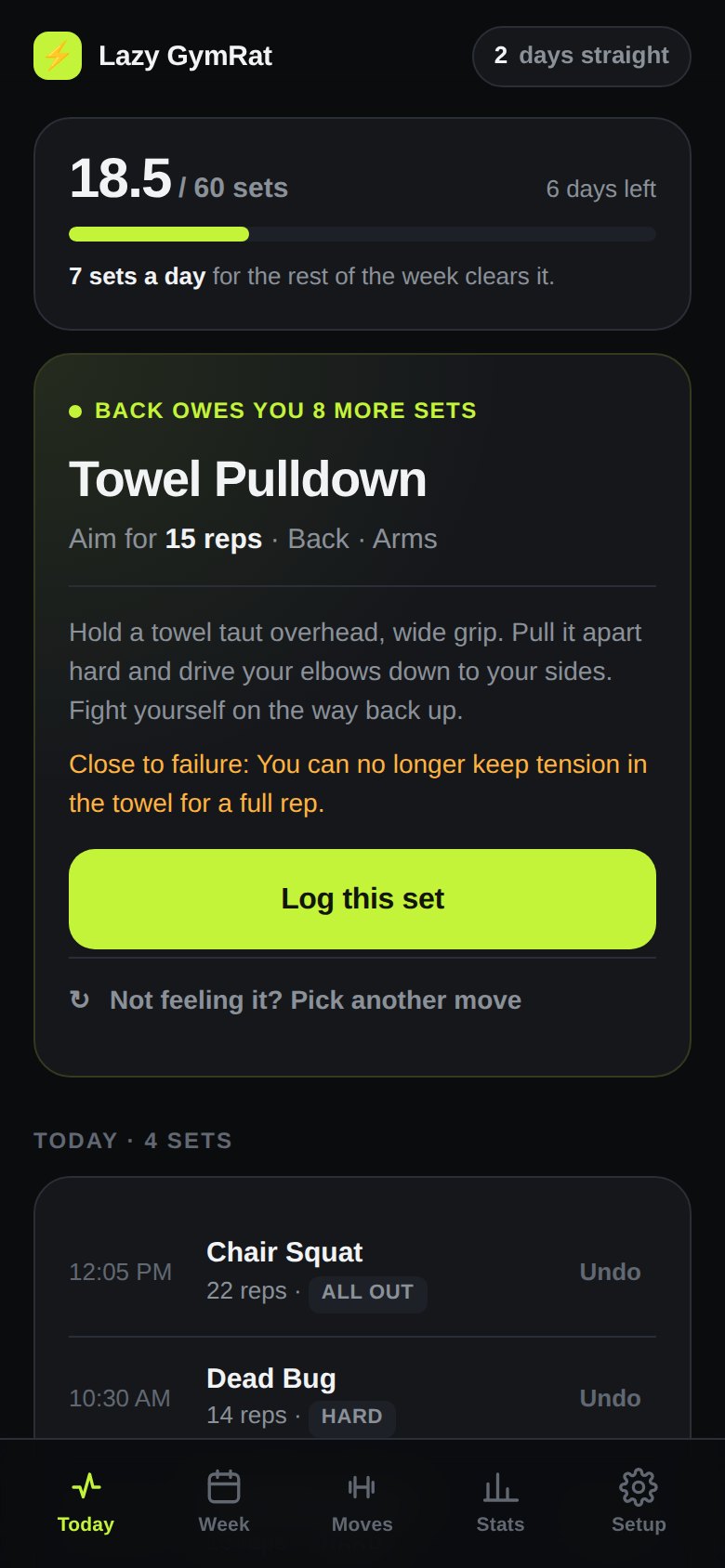
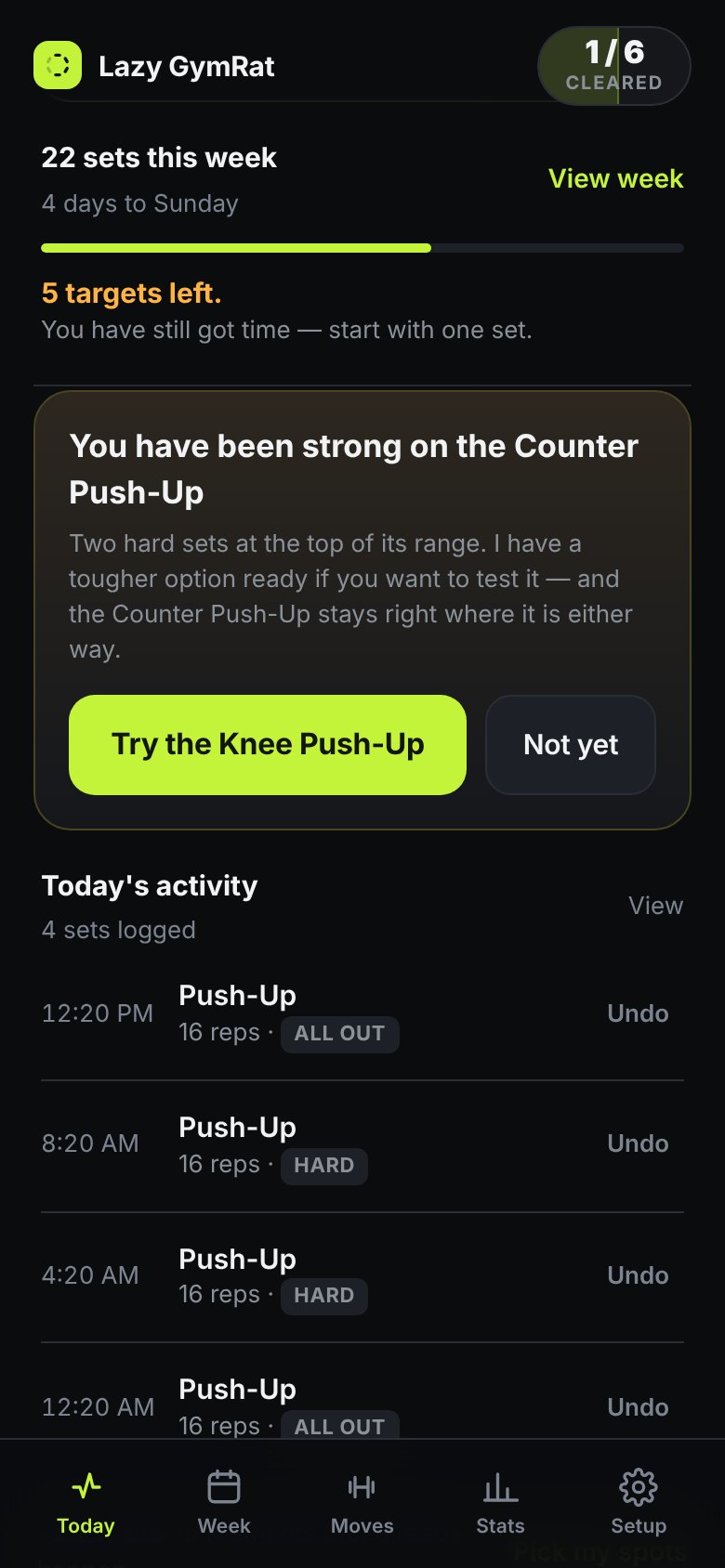
Today
You don’t open it to plan. You open it because you’ve got a few minutes. It has already looked at your week, your focus, where you are on every progression and what is in the room with you.
- 1 / 6 cleared The week has a finish line, and it is on every screen.
- 22 sets this week The work you actually did, kept separate from the score.
- Back is the biggest gap in your week It knows which area is being neglected, and it says why it picked this one.
- Floor Lat Pull It picks the move, from what is in your house.
- Aim for 19 reps It gives you a number, based on your last set.
Open it. Do the set. Get back to your day.
Week
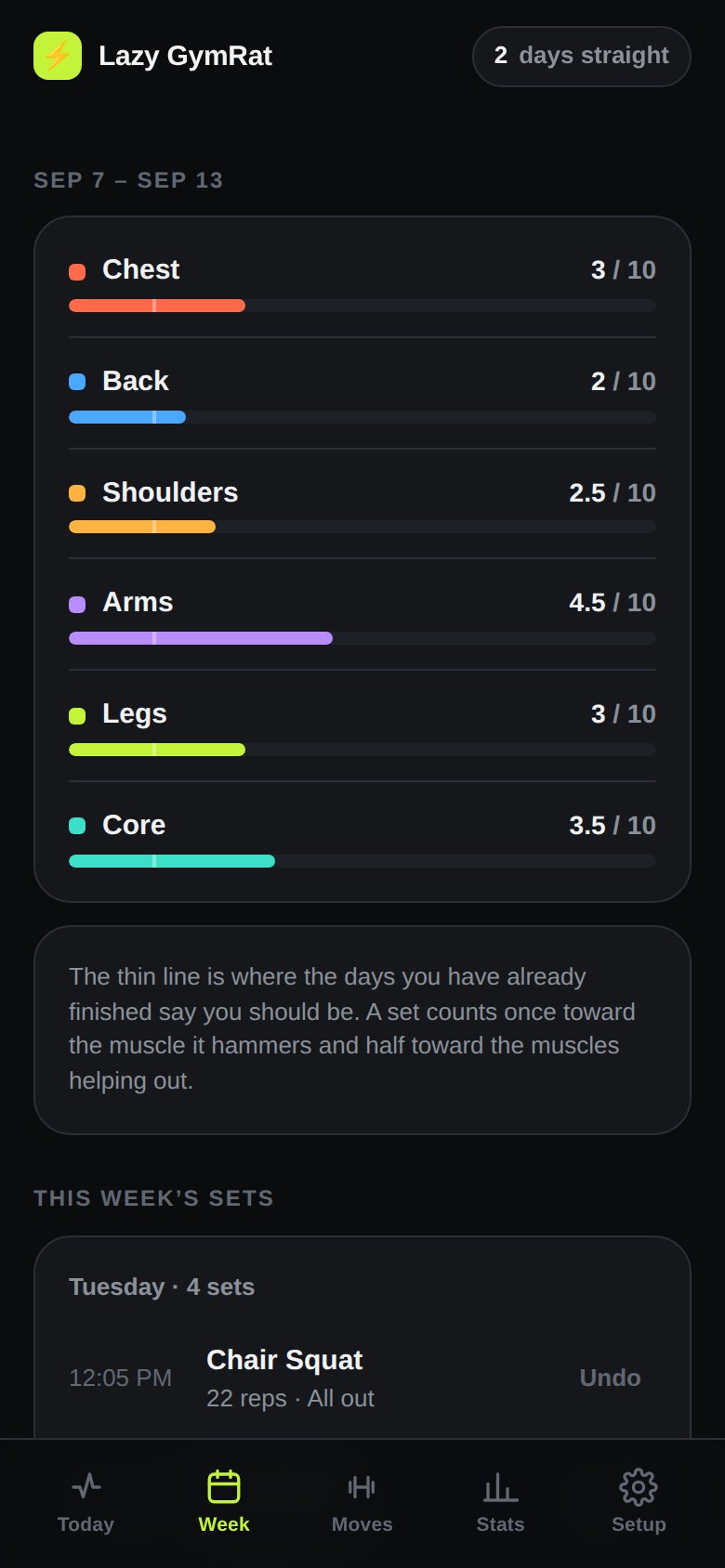
Your week is broken into targets. Every useful set moves one or more of them.
You don’t plan workouts. You clear the week.
The sets happen whenever life gives you room. The scoreboard keeps track of what is still short. Miss Tuesday and nothing resets. The week is the only deadline, and the app works out what is left.
One set can move more than one target. A push‑up is chest work, and your shoulders and arms did real work holding you up, so they take part of the credit too. That is why a handful of targets does not cost a handful of sessions: a full week lands around 40 to 50 sets, about six or seven a day. Most take under a minute, and they come to about 4 minutes of actual working‑set time a day: the sets themselves, not counting the walk to the doorframe or the two taps to log one.
Moves
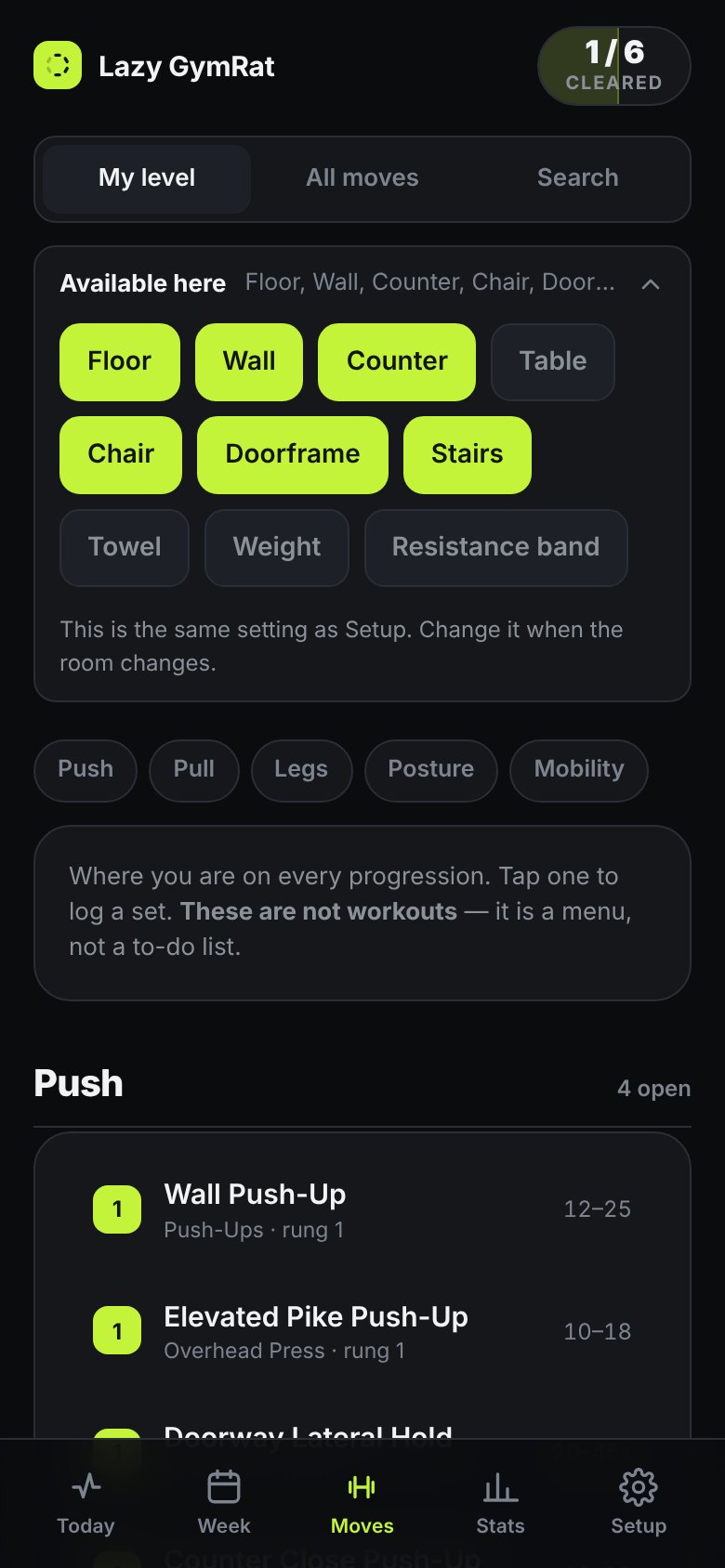
Your gym changes when your room changes. The app changes with it.
Tap what is available here and the whole catalogue adapts. Hotel room with a floor and a wall? Say so, and you get the moves that work in a hotel room with a floor and a wall.
106 currently offered moves across 23 progressions. The app sorts what fits your current setup and shows you what would unlock the rest.
“What if I don’t own anything?”
Then you use the room. A floor, a wall, a kitchen counter, a chair, a doorframe. Tell it which of those you have and the moves you can actually do come first. Nothing to go and buy.
It is also straight with you about what a room cannot do. A wall and a counter will not train a back, because a back needs something to pull against. Tick the doorframe and the rows open up, and the app tells you so rather than pretending otherwise.
Focus
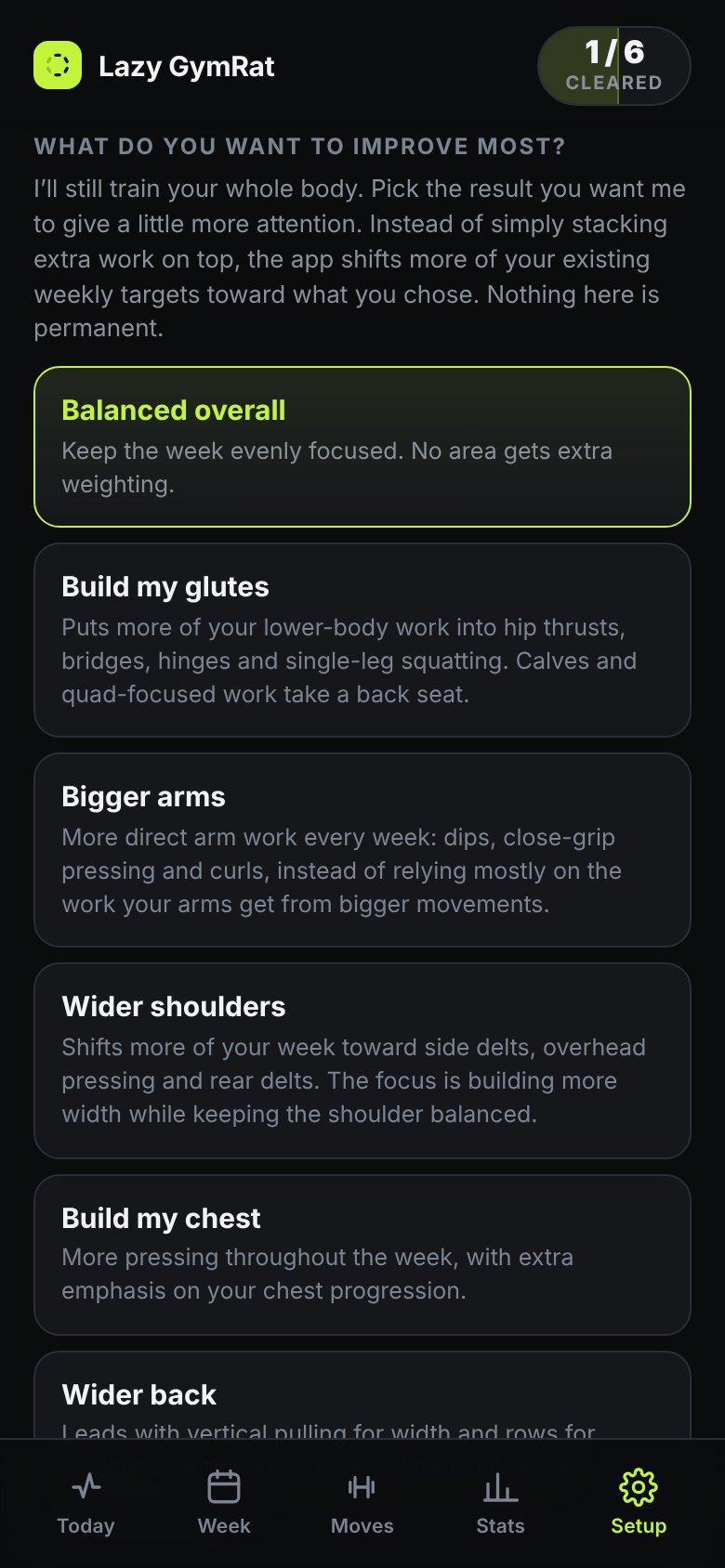
Pick one and more of your week goes to the movements that build it. Want wider shoulders? Side delts, overhead pressing and rear delts start coming up first. Everything else still gets trained: the app moves your existing week around rather than piling more on top of it. Change your mind whenever you like.
Core training builds the muscle. How much shows also comes down to body fat, which no amount of ab work decides. The app says so where you pick it.
“What if I’m starting from nothing?”
Then you are the easiest case. Coach Tee has you do one max set and reads your starting point off the number, for every movement at once, so your first move is one you can already do rather than a guess you made in a dropdown.
Got a dumbbell? Even better.
You do not need any of this to start. The whole story above happened without it. But a dumbbell, a kettlebell or a backpack with books in it all count as the same thing here: Weight.
Switch it on and more opens up.
Switch it off again in a hotel room and they go quiet, and everything you have already earned stays exactly where it was.
No card. No account. Nothing to cancel.
It grows with you.
That is the point, and it is handled. Counter push‑up, then the doorway, then the floor, then one arm. Hit the top of a rep range twice and the app offers you the next one up. You never decide when to move up, and you can turn an offer down and stay where you are.
Day one buyers, first week.
That is his story. Here is what other people have said on their own.
“I love how this is so practical and how the app holds me accountable with how many sets and reps I’ve done.”
“omg! Bro this is a brilliant idea and it’s been helping me tremendously since the first day I bought it!”
“I love the name of the app and love how it actually motivates me to work out. Aiming to hit that weekly quota next week! 😎”
And it keeps the receipts
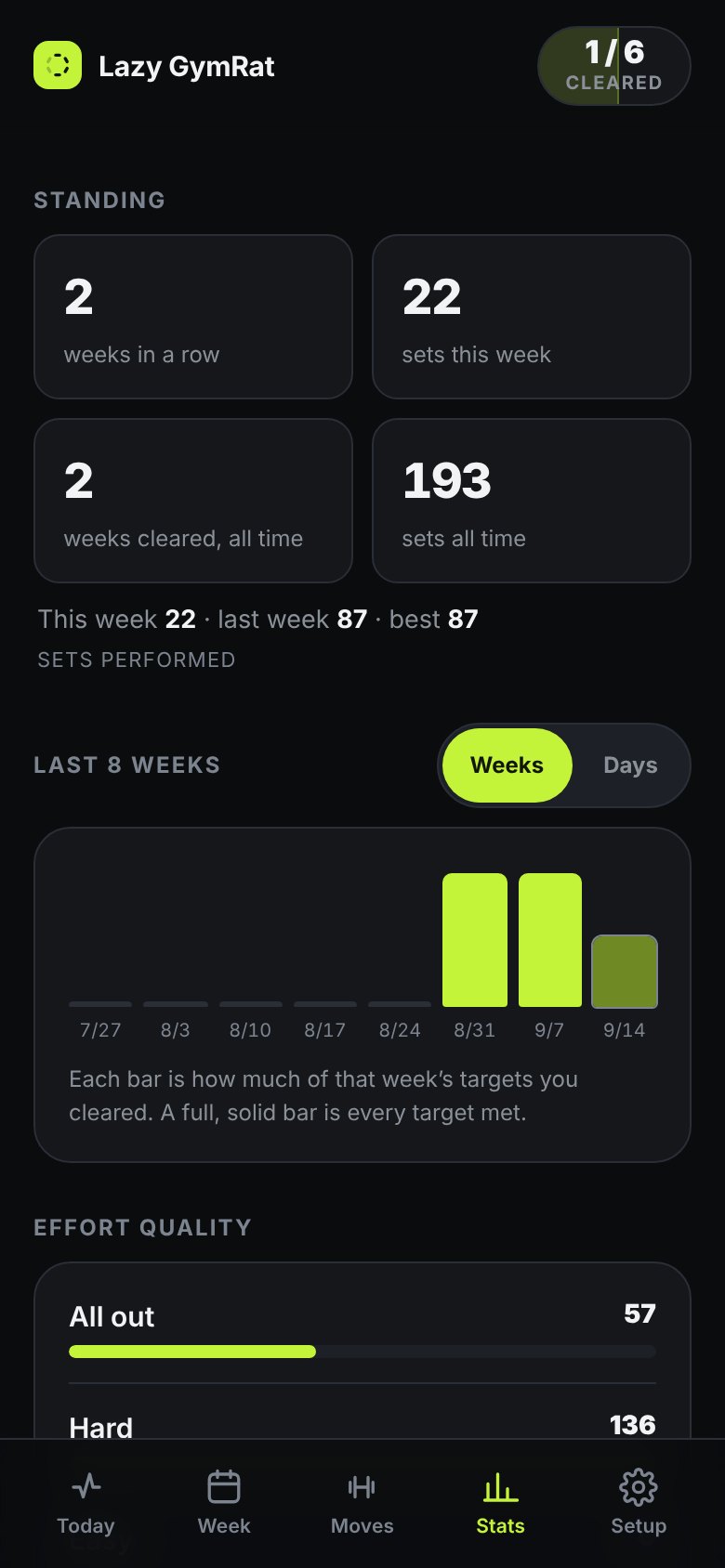
Weeks cleared, weeks in a row, and the last eight of them in a chart. No daily streak to panic about: a record of the weeks you actually finished, which tells you far more about whether somebody is still training in a year than any day counter can.
Does scattering sets actually count?
Yes, and not as a compromise. Muscle responds to hard sets taken close to failure, enough of them across a week, getting harder over time. None of that requires the sets to happen inside the same hour.
How that works, and why the sets do not have to be together.
Train hard enough to count
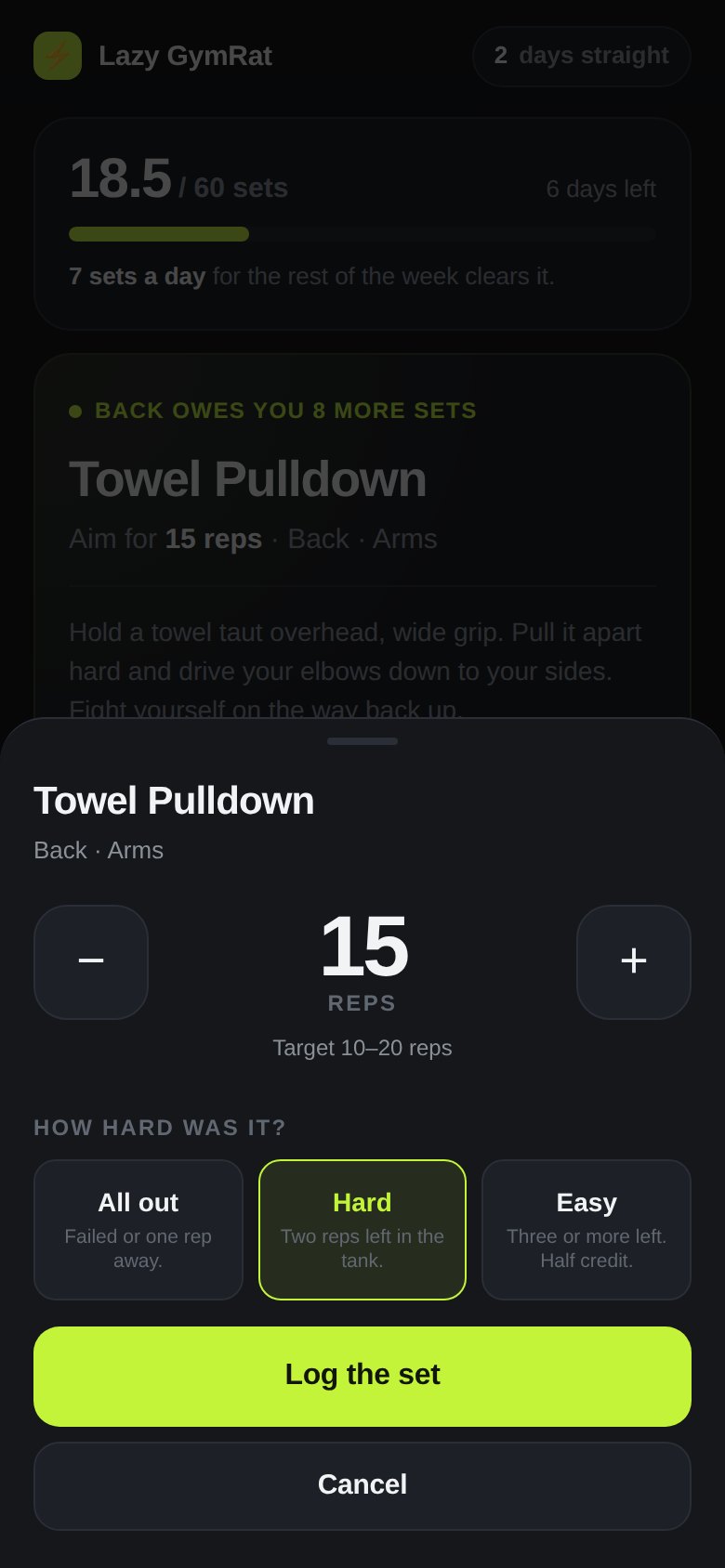
A set with five reps left in the tank is a warm‑up wearing a set’s clothes. You log All out, Hard or Easy, and an easy one earns half credit.
Get enough of them in a week
Everyone who studies this counts training the same way: hard sets, per muscle, per week. Ten for your chest is ten whether they came on Tuesday or over seven days.
Make the movement harder
Progressing a movement does the job that adding weight to a bar does. The app moves you up the ladder when you have earned it.
Your muscles cannot tell where they are
A muscle has no idea whether it is in a gym or your kitchen. It knows one thing: how close that last set came to failure. Equipment never built anybody. Getting close to failure did, and equipment is one way to get there rather than the only one.
Spread out, you can go harder than you could in a gym
A lifter rests two minutes between sets, so set four lands on a body that never recovered from set three. Your sets are hours apart. Every one starts fresh, and a fresh set is one you can finish with very little left in the tank. That is the trade: you give up the barbell and you get back the thing that decides whether a set grew anything.
Which is also why you cannot coast
Someone training in a gym can be sloppy. Four sets of chest back to back, and if two were soft the other two carry the session. You do not have that cushion. Your set is alone in a hallway with nothing behind it to make up the difference, and a week of soft sets is how people train for months and change nothing. Hard enough to count does not mean grinding every set into the floor: a rep or two short of failure is the range that builds, and the app asks you which one it was rather than guessing.
The set is the unit, not the workout
A workout is only the container hard sets arrive in. Your body counts the sets; it has no way of knowing whether they came in one trip or six.
This is not a new idea
Training in small pieces through the day has been done for decades under other names, by people who needed strength without a gym schedule. What has been missing is not the method. It is something that decides what you do next, keeps the running total, and makes the movement harder when you have earned it, so that none of it has to live in your head.
Before you buy.
How does the free trial work?
And they are three days you actually train, not three days on a calendar. A day only counts once you log a set. So if you start on a Friday and the weekend gets away from you, nothing is lost. Your three days are still waiting on Monday. Most trials punish you for having a life. This one doesn't.
There's an outer limit of a week so it can't be stretched forever, and it starts when you finish setup rather than when you land here, so looking around costs you nothing.
What happens when the three days end?
What does not happen is losing your training. Every set you logged stays in your log, you can still read it, and you can save a backup file any time, free, permanently. Pay whenever you like and you pick up exactly where you stopped, same week, same progress, nothing reset. Holding your own training hostage to a payment would be a rotten thing to do, and the app does not do it.
What if I miss days?
I just had a baby. Can I use this?
Will this get me toned?
What if I can’t get down on the floor?
What if I’m a complete beginner?
Do I need any equipment at all?
How does it get harder over time?
What happens to my data?
Which phone do I need?
Can I get a refund?
Try the whole thing first.
This is an unusual way to train and you should not have to take my word for it.
Launch price: $24.99. It becomes $39.99 on . Buy before then and you keep this one forever, including every update after the price rises.
- →Three days of the whole app, free, and they're three days you train, not three days on a clock. No card, no account, nothing to cancel.
- →A move for every room you are standing in, and a harder one waiting the moment you outgrow it. All 106 moves on 23 progression ladders, plus Coach Tee’s walkthrough and the calibration set that finds your level.
- →No daily streak to protect. Miss Tuesday and keep going: the week is the only deadline, and the app works out what is left.
- →Your full training history: weeks in a row, weeks you finished, and the eight‑week chart.
- →Offline, no account, no server, no analytics. Your training never leaves your phone.
- →One payment, yours for good. No subscription, no renewal, no second tier, and free updates forever.
Less than two months of a typical fitness subscription, and then it stops. Most apps rent you your own progress. This one is bought once.
He didn’t get more time.
He didn’t become somebody with unlimited free time. He became somebody who finally had a way to train with the time he already had.
You probably don’t need a completely different life either. You may just need a system that works inside the one you have got.
You handle the next set. The app handles the week.
Enough time for one set?
That is the whole ask. The app handles the rest of the week.
One payment. No subscription. Free updates.
Already using it? Tell me how it is going.
This opens your email app with the message ready to send. Nothing is submitted anywhere else, and nothing about you is stored on this site.